
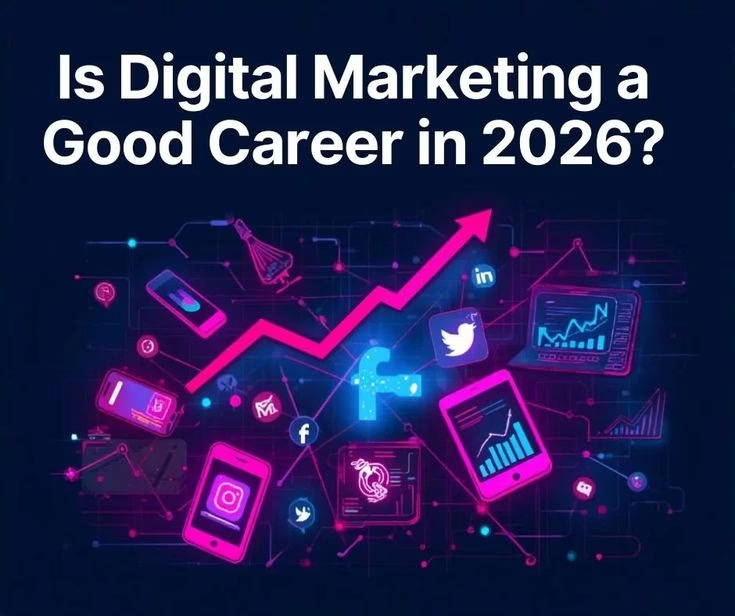
Digital Marketing Education is essential for mastering AI-driven strategies, immersive AR/VR technologies, and voice/visual search. Start with a hook about how the digital landscape has changed over the last year. In 2026, the barrier to entry is higher. It’s no longer just about posting on social media; it’s about understanding complex algorithms and data privacy. Digital marketing education has become one of the most valuable skills in today’s fast-evolving digital world. As businesses continue to shift online, the demand for professionals with strong digital marketing education is growing rapidly.
1. Businesses Demand Skilled Professionals
Companies today are not just looking for marketers—they are looking for strategic digital thinkers. Employers want professionals who can:
- Analyze data
- Understand consumer behavior
- Create high-converting campaigns
- Adapt to changing algorithms
Having theoretical knowledge is not enough. Practical, updated education gives you the competitive edge needed in today’s job market.
2. Rise of AI and Automation
There was a fear in 2024 that AI would kill marketing jobs. By 2026, the reality has set in: AI didn’t replace marketers, but marketers who use AI replaced those who don’t.
Digital marketing education in 2026 focuses heavily on “AI Orchestration.” This means knowing how to use AI to:
-
Predict Consumer Behavior: Using predictive analytics to know what a customer wants before they even search for it.
-
Hyper-Personalization: Sending a different email or showing a different website version to 10,000 different people based on their specific mood and past behavior.
-
Creative Decisioning: Using AI to test 500 variations of an ad in minutes to see which color palette or headline converts best in Calicut versus London.
Artificial Intelligence is transforming digital marketing. Tools now handle:
- Content generation
- Customer segmentation
- Ad optimization
- Chatbots and customer support
But here’s the truth: AI is a tool, not a replacement.
To use AI effectively, you need proper education. Without understanding strategy, audience psychology, and analytics, even the best tools won’t deliver results.
3. Opportunities for Freelancers and Entrepreneurs
One of the biggest advantages of digital marketing education is freedom. The “9-to-5” is fading. In 2026, the “Gig Economy” is the primary economy. Digital marketing is the ultimate freelance skill. It allows a specialist in Calicut to manage the SEO for a dental clinic in Dubai or a law firm in London.
In 2026, more people are choosing:
- Freelancing
- Remote work
- Personal branding
- Online businesses
With the right knowledge, you can:
- Build your own agency
- Manage clients globally
- Generate passive income streams
- Grow your personal brand (like my website sagad.in)

where skills meet innovation and careers are built online.
But to command high rates, you need a portfolio and a deep understanding of the latest tools. This is where sagad.In comes in—it’s not just a website; it’s a digital business card that proves you have the “2026-level” skills to drive revenue. Digital marketing education empowers you to become your own boss.
4. Cost-Effective Marketing for Businesses
Traditional marketing methods like TV ads and billboards are expensive and less targeted. Digital marketing, on the other hand, allows businesses to:
- Target specific audiences
- Track performance in real-time
- Optimize campaigns instantly
- But to achieve these results, businesses need skilled professionals.
There is a massive paradox in 2026: high unemployment in traditional sectors, yet a “talent war” in digital marketing. Companies are desperate for people who actually understand Performance Marketing and ROI-driven strategies. This creates a massive demand for trained digital marketers, making education in this field highly valuable. A degree from ten years ago doesn’t cover “Programmatic Advertising” or “Metaverse Brand Activations.” Continuous digital marketing education is the only way to remain “Future-Proof.” It’s a field where a 3-month intensive certification can often be more valuable than a 3-year general degree.
5. Constantly Changing Algorithms
Platforms like Google, Instagram, and Facebook update their algorithms frequently. Constantly changing algorithms in digital marketing—driven by platforms like Google, TikTok, and Meta to enhance user experience and curb spam—require marketers to shift from static strategies to agile, high-quality, and engagement-focused content. Adapting involves prioritizing authentic engagement, short-form video, leveraging AI-powered analytics, and adopting Generative Engine Optimization (GEO) to remain visible. What worked in 2024 may not work in 2026.
Without continuous learning, marketers can quickly fall behind.
Digital marketing education ensures you:
- Stay updated with trends
- Adapt strategies quickly
- Maintain consistent results
Key Reasons for Algorithm Changes
- User Experience (UX): Platforms prioritize personalized, relevant, and high-quality content to keep users engaged.
- Reduced Spam: Frequent updates, such as those from Google, filter out low-quality content and clickbait.
- Emerging Trends & Formats: Algorithms often shift to promote new features like Reels or TikTok-style short-form video.
- Monetization: Social platforms adjust to promote content that aligns with paid advertising models. The primary goal of social media platforms is to keep users on their platforms for as long as possible. As such, algorithms are constantly tweaked and refined to serve the most engaging content. While these changes often enhance the user experience, they can be challenging for marketers trying to maintain a consistent social media presence.
6. Data-Driven Decision Making
In 2026, marketing is no longer based on guesswork—it’s based on data.
Key metrics include:
- Conversion rates
- Click-through rates (CTR)
- Customer acquisition cost (CAC)
- Return on investment (ROI)
Understanding these metrics requires proper training.
7. Digital Marketing as a Tool for Social and Educational Change
As someone who works in both digital marketing and education (like the team behind PHYSCA), I’ve seen how these worlds collide. Digital marketing isn’t just about selling soap; it’s about:
-
Educational Outreach: Helping a student in a remote village find the best NEET/JEE coaching through targeted SEO.
-
Public Awareness: Using SMM (Social Media Marketing) to spread information about healthcare or civic duties.
Without digital marketing education, these vital messages get lost in the noise of the internet. One of the key advantages of digital marketing education is its practical approach to learning. Unlike traditional courses, digital marketing education focuses on real-world skills such as SEO, social media marketing, content creation, and paid advertising.