

Digital transformation is no longer optional. Whether you’re a startup founder, small business owner, or enterprise leader, your growth trajectory depends on how effectively you use digital channels to attract, convert, and retain customers.
In this in-depth guide, we will explore practical, scalable, and revenue-driven digital marketing strategies for business growth—from foundational principles to advanced performance tactics. This is not a theory. This is a growth blueprint.
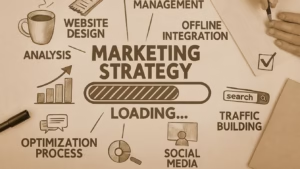
1. Understanding the Role of Digital Marketing in Business Growth
Business growth happens when three things improve:
- Customer acquisition
- Customer retention
- Customer value (LTV – Lifetime Value)
Digital marketing directly impacts all three.
Unlike traditional marketing, digital marketing allows:
- Precise audience targeting
- Real-time performance tracking
- Measurable ROI
- Automated scaling
- Data-driven decision making
When executed strategically, digital marketing becomes a revenue engine, not just a promotional activity.
2. Build a Strong Strategic Foundation
Think of your digital marketing as a skyscraper. Your website design, SEO, and content are the visible floors, but the strategy is the underground piling that keeps it from toppling over when the market shifts. A solid foundation ensures:
2.1 Define Clear Growth Objectives

Growth goals must be measurable. Examples:
- Increase revenue by 30% in 12 months
- Generate 500 qualified leads per month
- Improve conversion rate from 2% to 4%
- Reduce customer acquisition cost (CAC) by 20%
Without KPIs, marketing becomes guesswork.
2.2 Identify Your Ideal Customer
You must deeply understand:
- Demographics
- Pain points
- Buying triggers
- Objections
- Online behavior
- Preferred platforms
Create buyer personas. Growth accelerates when messaging aligns with real problems.
2.3 Clarify Your Unique Value Proposition (UVP)
Why should someone choose you over competitors?
Your UVP must answer:
- What do you solve?
- For whom?
- Why are you better?
Strong positioning reduces ad spend and increases conversion rates.
3. Search Engine Optimization (SEO): Long-Term Growth Engine
SEO is one of the most powerful digital marketing strategies for sustainable business growth. Think of SEO not as a marketing expense, but as a capital investment. By aligning your technical foundation with high-value content, you aren’t just “ranking”; you are building digital real estate. As your authority grows, the cost per acquisition (CPA) begins to drop, creating a “flywheel effect” where your past efforts continue to fuel future traffic without additional spend.

It generates:
- Organic traffic
- High-intent leads
- Brand authority
- Long-term ROI
3.1 On-Page SEO
Key elements:
- Keyword research
- Optimized headlines (H1, H2, H3)
- Meta titles and descriptions
- Internal linking
- Structured content
- Optimized images
Target commercial keywords like:
- “best CRM software for small business”
- “digital marketing consultant near me”
- “affordable accounting services”
These attract buying-intent users.
3.2 Technical SEO
Your website must:
- Load under 3 seconds
- Be mobile responsive
- Have a clean URL structure
- Use SSL security (HTTPS)
- Have optimized crawlability
Technical health directly affects rankings and conversion.
3.3 Content SEO Strategy
Create:
- Blog posts
- Pillar pages
- Case studies
- Comparison articles
- Industry guides
Content should address every stage of the buyer journey:
- Awareness
- Consideration
- Decision
SEO compounds over time. It’s a long-term growth multiplier.
4. Content Marketing: Authority Builds Revenue
Content marketing builds trust. Trust builds sales. In the modern digital landscape, “content” is often treated as a commodity—a box to check or a keyword to stuff. However, for businesses looking to scale, there is a massive distinction between simply producing content and building Content Authority.
While standard marketing focuses on the transaction, authority-driven marketing focuses on the transformation. When a brand consistently solves problems through high-value, insightful content, it ceases to be a vendor and becomes a trusted advisor. This shift doesn’t just increase traffic; it fundamentally alters your bottom line in three specific ways:
-
Shortening the Sales Cycle: Authority builds “pre-sold” leads. When prospects have already consumed your expertise, the education phase of the sales process happens on autopilot.
-
Commanding Premium Pricing: In a race to the bottom, the cheapest wins. In a race for results, the most authoritative wins. Content authority allows a business to step out of the “commodity” price bracket.
-
Compound Organic Growth: Unlike paid ads that stop the moment you stop paying, authoritative content acts as a long-term asset, generating leads and revenue long after the “Publish” button is clicked.
When done correctly, content:
- Educates prospects
- Reduces buying resistance
- Demonstrates expertise
- Improves SEO
- Nurtures leads
4.1 Types of High-Impact Content
- Blog articles
- Whitepapers
- E-books
- Webinars
- Videos
- Case studies
- Infographics
- Email newsletters
4.2 Content Funnel Strategy
Top of Funnel (TOFU):
- Educational blog posts
- Social media tips
- Explainer videos
Middle of Funnel (MOFU):
- Case studies
- Webinars
- Email sequences
Bottom of Funnel (BOFU):
- Free trials
- Demo bookings
- Testimonials
- Pricing pages
Content should guide users toward conversion—not just generate traffic.
5. Social Media Marketing: Community and Visibility
In the modern digital economy, social media has evolved from a simple megaphone for brand messages into a complex ecosystem of micro-communities and algorithmic discovery. Social media builds brand presence and customer relationships. For a business to thrive, its strategy must address two distinct but symbiotic pillars: Visibility and Community.

1. The Visibility Pillar: Discovery in a Fragmented Market
Visibility is the “top-of-funnel” engine. It is about breaking through the noise to reach individuals who don’t yet know your brand exists. In 2026, visibility is no longer just about high-volume posting; it is driven by Social SEO and High-Resonance Content.
-
Search-First Social: With over 25% of users now using TikTok and Instagram as their primary search engines, visibility relies on keyword-optimized captions and “shoppable” metadata.
-
The Power of “Hooks”: In an era of infinite scroll, visibility is won in the first two seconds. Short-form vertical video remains the dominant format for triggering the algorithms that push content to “For You” pages.
-
Strategic Reach: True visibility isn’t just about “going viral”; it’s about appearing in the feeds of high-intent users through precise interest-cluster targeting.
2. The Community Pillar: From Followers to Advocates
If visibility brings people to the door, community is what invites them inside to stay. A community-first approach shifts the focus from vanity metrics (likes and impressions) to depth metrics (DMs, saves, and meaningful comment threads).
-
The Digital Campfire: Modern audiences are moving away from public “town squares” and toward “digital campfires”—smaller, gated spaces like Discord servers, WhatsApp broadcast channels, and private LinkedIn groups.
-
Co-Creation and Authenticity: Building community requires a shift from “talking at” to “talking with.” This involves user-generated content (UGC), real-time Q&As, and transparent storytelling that humanizes the brand.
-
Retention and Loyalty: A strong community lowers customer acquisition costs (CAC) by turning one-time buyers into long-term brand advocates who provide organic word-of-mouth marketing.
The Strategic Synergy
A business that focuses only on Visibility is a “leaky bucket”—constantly spending to find new people who never stick around. Conversely, a business that focuses only on Community may have deep loyalty but will eventually stagnate without fresh growth.
The most effective digital marketing strategies in 2026 use visibility to fuel community growth and use community insights to create more visible, high-performing content.
Platforms to consider:
- LinkedIn (B2B)
- Instagram (visual brands)
- Facebook (broad audience)
- YouTube (long-form education)
- X (thought leadership)
- Pinterest (lifestyle niches)
5.1 Organic Strategy
Focus on:
- Educational posts
- Industry insights
- Behind-the-scenes content
- Customer success stories
- Short-form videos
Consistency matters more than volume.
5.2 Paid Social Advertising
Paid campaigns allow:
- Laser-targeted audience selection
- Retargeting website visitors
- Lookalike audience expansion
- Sales-focused campaigns
For growth, combine organic trust-building with paid scaling.
6. Performance Marketing: Data-Driven Sales Acceleration
In the traditional marketing world, you often pay for “potential”—the hope that an ad was seen or a brand was remembered. Performance marketing flips the script. It is a results-oriented discipline where every dollar spent is tied directly to a specific action, whether that’s a lead, a click, or a completed sale.
By leveraging real-time data, businesses can stop guessing and start scaling. It’s not just about running ads; it’s about a continuous cycle of analysis, optimization, and conversion.

Why Performance Marketing is the Growth Engine of 2026
While brand awareness is the “soul” of a business, performance marketing is the engine. Here is why it’s essential for modern digital strategy:
-
Measurable ROI: Unlike a billboard, you know exactly which $100 generated $500 in revenue.
-
Agile Optimization: Data allows you to “kill” underperforming campaigns instantly and double down on what works.
-
Low Risk, High Reward: Because you pay for results (CPA – Cost Per Acquisition), your marketing budget becomes a predictable investment rather than an overhead cost.
-
Precision Targeting: Using advanced attribution models, you reach the right customer at the exact moment they are ready to pull the trigger.
The Core Philosophy: Performance marketing isn’t about being “loud” on the internet; it’s about being accurate. It transforms the marketing department from a cost center into a primary driver of sales acceleration.
Performance marketing focuses on measurable outcomes:
- Cost per lead (CPL)
- Cost per acquisition (CPA)
- Return on ad spend (ROAS)
Channels include:
- Google Ads
- Social Media Ads
- Display Ads
- Retargeting Ads
- Affiliate Marketing
6.1 Search Ads
Search ads capture high-intent users actively looking for solutions.
Example:
If someone searches “best digital marketing agency for e-commerce,” they are ready to buy.
6.2 Retargeting Strategy
Only 2–5% of users convert on their first visit.
Retargeting:
- Brings back warm traffic
- Reduces CPA
- Increases conversion rate
Growth-focused businesses always implement retargeting.
7. Email Marketing: High ROI Growth Channel
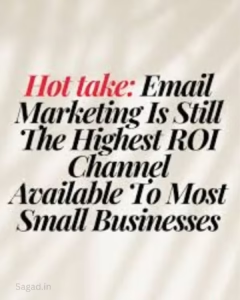
While flashy new platforms emerge every season, Email Marketing remains the undisputed heavyweight champion of Return on Investment (ROI). Email marketing consistently delivers one of the highest ROIs in digital marketing. For every $1 spent, the average return hovers around $36 to $42, a figure that leaves most social media channels in the dust.
Why It’s the Ultimate Growth Channel
Email isn’t just a communication tool; it’s a direct line to your most engaged customers. In a world of “rented” audiences on Facebook or Instagram, your email list is an asset you own and control.
-
Precision Targeting: Unlike broad-spectrum ads, email allows for hyper-segmentation. You can talk to a first-time lead differently than a 5-year loyalist.
-
Behavioral Automation: By triggering emails based on user actions—like abandoning a cart or downloading a whitepaper—you create a “24/7 salesperson” that works while you sleep.
-
The Trust Factor: An inbox is a private space. When a customer invites you in, you aren’t just a brand; you become a personalized consultant delivering value directly to their pocket.
Beyond the “Send” Button
To truly unlock high-ROI growth, a digital strategy must move past generic blasts. Successful campaigns today leverage A/B testing, personalized dynamic content, and clean data hygiene to ensure deliverability. When done right, email marketing doesn’t just grow your traffic—it scales your bottom line by turning casual browsers into brand advocates.
Why?
- You own the audience.
- Direct communication.
- Automated nurturing.
- Repeat sales.
7.1 Build an Email List
Methods:
- Lead magnets

Still the King of ROI: Email Marketing - Free resources
- Discount offers
- Webinars
- Newsletters
7.2 Automation Sequences
Create:
- Welcome sequence
- Nurture sequence
- Abandoned cart emails
- Upsell and cross-sell emails
- Re-engagement campaigns
Automation turns leads into long-term customers.
8. Conversion Rate Optimization (CRO): Multiply Existing Traffic
Many businesses fall into the “more is better” trap, spending thousands on ads and SEO to drive more visitors to their site. But if your website is a “leaky bucket,” more water isn’t the solution—fixing the holes is. This is where Conversion Rate Optimization (CRO) becomes your most powerful competitive advantage.
What is CRO?
At its core, CRO is a systematic process of increasing the percentage of website visitors who take a specific action—whether that’s purchasing a product, signing up for a newsletter, or filling out a contact form.
Instead of focusing on quantity (getting more people to the site), CRO focuses on quality and experience (getting the people already there to convert).
Why CRO is the “Growth Multiplier”
-
Lower Acquisition Costs: When you double your conversion rate, you effectively cut your Cost Per Acquisition (CPA) in half. You’re getting more value out of every dollar already spent on marketing.
-
Better User Insight: CRO isn’t about guessing; it’s about data. Through A/B testing, heatmaps, and user feedback, you learn exactly what makes your customers tick (and what turns them off).
-
Compounding Returns: Unlike a one-off ad campaign, the UI/UX improvements you make via CRO stay on your site forever, providing a permanent lift in revenue.
The Strategy: Stop Guessing, Start Testing
Effective CRO involves looking at your “Optimization Process” through several lenses:
-
Technical Health: Is the site fast? Does it work on mobile?
-
Clarity: Is the value proposition immediately obvious?
-
Friction: Are there too many form fields or a confusing checkout process?
-
Urgency: Are you giving them a reason to act now?
The Bottom Line: You don’t always need more traffic to grow your business; sometimes, you just need to be better at serving the traffic you already have.
8.1 Key CRO Elements
- Clear call-to-action (CTA)
- Fast loading speed
- Trust badges
- Social proof
- Testimonials
- Simple forms
- Strong headlines
Test everything.
Use A/B testing to refine:
- Button color
- CTA wording
- Landing page layout
- Pricing presentation
Small improvements create exponential growth.
9. Influencer and Partnership Marketing
In the modern digital landscape, Strategic partnerships expand reach. The traditional sales funnel is being replaced by a “Trust Loop.” While traditional ads interrupt the consumer experience, Influencer and Partnership Marketing weave your brand into the communities where your customers already live, learn, and play.
What is Influencer Marketing?
At its core, influencer marketing is the practice of collaborating with content creators who have cultivated a loyal, engaged audience. In 2026, the industry has moved away from “vanity metrics” (like follower counts) toward engagement quality and niche authority.
-
Micro and Nano-Influencers: Brands now prioritize creators with 5k to 50k followers because their “hyper-local” or “hyper-niche” influence often yields a higher ROI and more authentic conversions than celebrity endorsements.
-
The AI Shift: Marketers are increasingly using AI-driven discovery tools to match brands with creators whose audience sentiment and core values perfectly align, ensuring that partnerships feel organic rather than forced.
What is Partnership Marketing?
Partnership marketing is a broader strategic umbrella. It involves two or more entities—brands, creators, or platforms—combining their resources to reach a mutual goal. While influencer marketing is a type of partnership, this category also includes:
-
Affiliate Partnerships: Performance-based collaborations where partners earn a commission on every sale they drive.
-
Brand-on-Brand Collabs: Two non-competing brands (e.g., a fitness app and a health food brand) co-creating a campaign to tap into each other’s user bases.
-
Strategic Ambassadors: Long-term relationships where a creator becomes a “face” of the brand, moving beyond one-off posts to co-developing products or hosting community events.
Why It’s Essential for Modern Business
-
Cutting Through the Noise: With the rise of AI-generated content, consumers are craving “human-first” recommendations. A trusted creator’s voice acts as a filter for the overwhelmed shopper.
-
Social Commerce Integration: Platforms like TikTok Shop and YouTube Shopping have turned influencers into direct sales channels. A partnership today is often a frictionless “see it, buy it” experience.
-
Data-Backed ROI: Unlike the “spray and pray” billboard ads of the past, partnership marketing is highly trackable. Using unique promo codes, UTM links, and attribution dashboards, businesses can see exactly which partner is driving the most lifetime value (LTV).
The Bottom Line
Influencer and Partnership Marketing isn’t just about a “shoutout.” It’s about building a multi-touchpoint strategy where your brand is validated by voices your customers already trust. For a business to thrive in 2026, it must stop talking at its audience and start talking with them through the partners they admire.
Collaborate with:
- Industry influencers
- Complementary businesses
- Micro-influencers
- Affiliate partners
Benefits:
- Immediate audience access
- Enhanced credibility
- Faster brand awareness
Micro-influencers often generate higher engagement and better ROI.
10. Video Marketing: The Growth Accelerator
Video content increases:
- Engagement
- Retention
- Conversion rates
In an era of dwindling attention spans, video has emerged as the most potent tool in the digital marketer’s arsenal. While static images and text provide information, video provides immersion. For businesses looking to scale, video marketing acts as a high-octane growth accelerator, transforming passive viewers into active brand advocates.
Why Video Drives the Bottom Line
The “acceleration” happens because video hits three critical business pillars simultaneously:
-
Humanizing the Brand: Video allows for tone, facial expressions, and music, which build trust much faster than any other medium. In the “Strategy” world, trust is the shortest path to conversion.
-
Boosting SEO and Dwell Time: Search engines prioritize pages with video content. By keeping users on your site longer, you signal to algorithms that your content is valuable, driving organic traffic.
-
Simplifying the Complex: Whether it’s a SaaS demo or a complex logistics service, a 60-second explainer video can do the work of a 2,000-word whitepaper.
The Strategic Implementation
To use video as a true accelerator, it must be mapped to the Customer Journey:
Stage Video Type Goal Awareness Short-form Social (Reels/TikToks) Reach and Brand Recall Consideration Explainer Videos & Webinars Education and Lead Gen Decision Case Studies & Video Testimonials Social Proof and Closing the Sale Video marketing is no longer about “going viral”; it’s about strategic visibility. By integrating video into your overarching digital strategy, you create a repeatable framework for engagement that works 24/7. In the race for market share, those who leverage the moving image don’t just participate—they lead.
-
Types of video:
- Product demos
- Explainer videos
- Customer testimonials
- Educational content
- Live sessions
Short-form video (Reels, Shorts) builds awareness.
Long-form video builds authority.
11. Marketing Automation and CRM Integration
As businesses grow, manual processes limit scalability.

Use:
- CRM systems
- Marketing automation tools
- Lead scoring
- Behavioral tracking
Benefits:
- Better lead qualification
- Personalized messaging
- Improved sales alignment
- Higher close rates
Sales and marketing must operate as one system.
12. Data Analytics and Continuous Optimization
In the modern landscape, digital marketing strategies without data are merely guesswork. In 2026, the businesses that dominate their niche are those that have moved beyond “checking the numbers” once a month and have instead built a culture of continuous, data-driven optimization. Successful digital marketing strategies are driven by data rather than assumptions. Digital platforms provide detailed insights into customer behavior, campaign performance, and user engagement. Businesses that actively analyze this data can make informed decisions, improve marketing efficiency, and achieve sustainable growth.
12.1Understanding Key Marketing Metrics
To evaluate the effectiveness of digital marketing strategies, businesses must monitor important performance indicators. Metrics such as website traffic, conversion rate, cost per acquisition (CPA), click-through rate (CTR), and customer lifetime value provide valuable insights into how marketing efforts contribute to business growth. Tracking these metrics helps identify which channels and campaigns deliver the best results.
12.2Using Data to Improve Campaign Performance
One of the greatest advantages of digital marketing is the ability to continuously refine strategies based on real-time data. Businesses can analyze campaign performance, identify areas that need improvement, and adjust targeting, messaging, or budget allocation accordingly. By regularly reviewing analytics, companies can strengthen their digital marketing strategies and maximize return on investment.
12.3A/B Testing and Experimentation
Testing different marketing approaches is an essential part of optimization. Through A/B testing, businesses can compare variations of landing pages, advertisements, email campaigns, or website layouts to determine which performs better. This data-driven experimentation allows marketers to refine their digital marketing strategies and improve conversion rates over time.
12.4Customer Behavior Insights
Data analytics also reveals valuable insights into customer preferences and behavior. Businesses can analyze user journeys, identify the most effective touchpoints, and understand what motivates customers to make purchasing decisions. These insights help marketers design digital marketing strategies that deliver more personalized and relevant experiences.
12.5Continuous Optimization for Long-Term Growth
Digital marketing is not a one-time effort but an ongoing process. Markets change, customer expectations evolve, and new technologies emerge. Businesses that continuously analyze performance data and adapt their digital marketing strategies are better positioned to stay competitive and maintain long-term growth.
Ultimately, data analytics transforms marketing from guesswork into a strategic, measurable process. When businesses commit to continuous optimization, their digital marketing strategies become more effective, efficient, and capable of driving consistent business success.
Track:
- Traffic sources
- Conversion rate
- Bounce rate
- Cost per lead
- ROAS
- Customer lifetime value
Use data to:
- Allocate budget effectively
- Eliminate underperforming campaigns
- Scale profitable channels
Growth requires ongoing optimization.
13. Customer Retention Strategies for Sustainable Growth
Acquiring a new customer can cost up to 5 times as much as retaining an existing one. In the landscape of 2026, digital marketing strategies have shifted from simple acquisition to building long-term, “sticky” relationships. Sustainable growth isn’t just about filling the top of the funnel; it’s about plugging the leaks at the bottom.
13.1 Personalization at Scale (AI-Driven Retention)
Modern customers expect you to remember them. Using digital marketing strategies like behavioral tracking and AI-powered segmentation, you can deliver “segment-of-one” experiences.
-
Dynamic Content: Show personalized product recommendations based on past purchases.
-
Automated Lifecycle Emails: Send “We miss you” campaigns or replenishment reminders exactly when a customer is likely to run out of a product.
13.2 Building a “Digital Campfire” (Community Marketing)
In 2026, people are moving away from broad social feeds toward private, high-trust communities.
-
Niche Spaces: Create Discord servers, WhatsApp broadcast channels, or exclusive LinkedIn groups where your best customers can interact with your brand and each other.
-
Co-Creation: Invite your community to vote on new product features or provide feedback. When customers feel like “insiders,” they become lifelong brand advocates.
13.3 Tiered Loyalty & Gamification
Static loyalty cards are a thing of the past. To keep engagement high, your digital marketing strategies must include rewarding interactions, not just transactions.
-
Tiered Rewards: Use Bronze, Silver, and Gold tiers to give customers something to strive for.
-
Gamification: Award “badges” for social media shares, reviews, or reaching milestones (e.g., a “1-year anniversary” reward).
13.4 Proactive Customer Support & Self-Service
Retention thrives when friction is low.
-
AI Agents: Implement 24/7 AI-powered support to resolve common queries instantly.
-
Knowledge Hubs: Build a robust library of tutorials and “how-to” videos. If a customer can successfully use your product to its full potential, they are far less likely to churn.
Retention strategies:
- Loyalty programs
- Personalized email campaigns
- Excellent customer service
- Regular engagement
- Exclusive offers
Increase lifetime value to boost long-term growth.
14. Omnichannel Strategy: Unified Brand Experience
In the modern landscape, digital marketing strategies are no longer about picking a single platform; they are about creating a “Trust Loop” that follows the customer across every device. An omnichannel strategy ensures that whether a customer finds you on Instagram, receives an email, or visits your physical office in Calicut, the experience is seamless.
Why Omnichannel is the Growth Multiplier
A unified experience removes friction. When your messaging is consistent, you don’t just reach a customer—you stay top-of-mind. Research shows that businesses with strong omnichannel engagement retain an average of 89% of their customers, compared to only 33% for those with weak strategies.
To implement this as part of your broader digital marketing strategies, focus on these three pillars:
-
Consistent Brand Voice: Your tone, visuals, and value proposition must be identical on LinkedIn, your website, and your WhatsApp Business account.
-
Data Integration: Use a CRM to ensure that if a customer asks a question on Facebook, your email support team already has the context of that conversation.
-
Cross-Channel Retargeting: If a user abandons a cart on your website, your social media ads should dynamically update to offer them a helpful reminder or a limited-time discount.
Customers interact across multiple touchpoints:
- Website
- Social media
- Ads
- Offline interactions
Ensure consistency:
- Messaging
- Branding
- Tone
- Value proposition
Integrated campaigns increase trust and conversion.
15. Budget Allocation for Maximum ROI
In the world of digital marketing strategies, your budget is your fuel. If you spray it across every platform without a plan, you’ll run out of gas before you see a return. Smart allocation isn’t about spending the most; it’s about spending where the data shows the least resistance to conversion.
To achieve maximum ROI, a business must balance “Long-Term Equity” (SEO and Content) with “Short-Term Wins” (Paid Ads).
The 70-20-10 Rule for Scaling
For a growth-focused business, I recommend a strategic split to ensure your digital marketing strategies remain both stable and innovative:
-
70% to Proven Channels: Direct your largest share toward the channels currently driving your lowest Cost Per Acquisition (CPA). This is usually Google Search Ads or Email Marketing.
-
20% to Growth Experiments: Use this to test new digital marketing strategies, such as moving into TikTok social SEO or testing micro-influencer partnerships in the Calicut market.
-
10% to Pure Innovation: Reserve a small portion for high-risk, high-reward tactics like AI-driven interactive content or emerging social platforms.
Smart budget distribution matters.
Typical growth-focused split:
- 30% Paid ads
- 25% Content & SEO
- 15% Social media
- 10% Email marketing
- 10% CRO
- 10% Tools & analytics
Adjust based on performance.
| Category | Budget % | Growth Impact |
| Performance Marketing (Ads) | 30% | Immediate Lead Generation |
| SEO & Content Authority | 25% | Sustainable Organic Traffic |
| Social Media & Community | 15% | Brand Trust & Visibility |
| Email & Retention | 10% | Maximizing Customer LTV |
| CRO (Website Optimization) | 10% | Turning Traffic into Cash |
| Analytics & Tools | 10% | Data-Driven Decisions |
16. Common Mistakes That Limit Business Growth
Avoid:
Identifying the right digital marketing strategies is only half the battle; avoiding the pitfalls that stall momentum is where the real growth happens. Even with a year of experience as a freelancer, it’s easy to see how these common errors can silently drain a budget and kill conversions. Even the most promising businesses struggle when their digital marketing strategies lack structure, consistency, or data-driven decision-making. While digital channels offer enormous opportunities for growth, many companies fail to realize their potential because of avoidable strategic mistakes.
Here are the most significant mistakes to avoid if you want to keep your growth trajectory on track:
1. Treating Social Media Like a Billboard (Not a Funnel)
Many businesses post content randomly without a clear objective. In 2026, visibility alone doesn’t pay the bills. The mistake is focusing on “vanity metrics” like likes and follows rather than building a social media funnel.
-
The Fix: Every post should have a purpose—whether it’s to build awareness, drive traffic to a lead magnet, or nurture existing followers toward a purchase.
2. Ignoring Search Intent in SEO
A common SEO error is targeting high-volume keywords without considering the user’s intent. If you optimize for “best running shoes” but your landing page only offers “shoe repair,” you’ll have a high bounce rate.
-
The Fix: Align your digital marketing strategies with the four pillars of intent: Informational, Navigational, Commercial, and Transactional.
3. Relying Solely on “Rented” Land
Algorithm changes can wipe out your reach overnight. Relying entirely on Instagram or Facebook is risky because you don’t own that audience.
-
The Fix: Use social media to drive traffic to your owned channels, specifically your website and email list. This ensures that even if an algorithm shifts, your business remains stable.
4. Neglecting the “Mobile-First” Reality
With over 60% of web traffic coming from mobile devices, a slow or clunky mobile experience is the fastest way to lose a customer. Google’s mobile-first indexing means if your site isn’t optimized for phones, your rankings will suffer regardless of how good your content is.
-
The Fix: Use tools like Google PageSpeed Insights to ensure your site loads in under 3 seconds and has intuitive, touch-friendly navigation.
5. Data Without Action (The Analytics Trap)
Collecting data from GA4 or Meta Pixel is useless if you aren’t using it to pivot. Many businesses look at their monthly reports but never change their tactics based on the numbers. Digital marketing provides powerful data insights, yet many businesses ignore analytics. Without monitoring metrics like conversion rates, traffic sources, and cost per acquisition, it becomes impossible to understand what is working and what is not. Data-driven digital marketing strategies help businesses optimize campaigns and improve performance continuously.
-
The Fix: Move beyond basic metrics. Track your Cost Per Acquisition (CPA) and Customer Lifetime Value (LTV). If a channel isn’t producing a positive ROI, reallocate that budget to a high-performer.
- No clear strategy
- Ignoring data
- Poor website experience
- Inconsistent branding
- Focusing only on traffic, not conversion
- Not aligning marketing with sales
Growth requires alignment and discipline.
17. Scaling Strategies for Advanced Growth
Once your business has established a steady flow of leads, the next phase is to move from maintenance to momentum. To achieve this, your digital marketing strategies must shift from manual efforts to a systematic, high-octane growth engine. Scaling is not about doing more of the same; it is about increasing your output and impact without a proportional increase in costs.
Once the foundation of your marketing system is strong, the next step is scaling. Businesses that achieve sustainable growth do not simply increase their marketing budget—they refine and expand their digital marketing strategies to reach new audiences, improve efficiency, and maximize revenue.
Scaling requires a systematic approach that combines data analysis, automation, and strategic expansion across multiple digital channels.
17.1 Leverage AI and Predictive Analytics
In 2026, scaling relies on foresight. Use AI-driven tools to move beyond reporting on what happened and start predicting what will happen. Not every marketing channel produces the same results. Advanced digital marketing strategies focus on identifying the most profitable channels and scaling them strategically. If SEO generates qualified leads, invest more in content and keyword expansion. If paid advertising delivers a strong ROI, increase budget allocation and refine targeting. Predictive analytics allow you to:
-
Identify high-value leads before they enter the decision stage.
-
Optimize ad bidding in real-time to maintain a high ROAS (Return on Ad Spend).
-
Anticipate seasonal shifts in search intent to stay ahead of competitors.
-
17.2 Personalization at Scale
Mass marketing is a relic of the past. To scale effectively, you must deliver hyper-personalized experiences to thousands of users simultaneously. By integrating your CRM with advanced automation, you can serve:
-
Dynamic Website Content: Displaying different homepage banners based on a user’s previous browsing behavior.
-
Segmented Email Journeys: Triggering specific sequences based on precise behavioral data (e.g., a “VIP” flow for high-LTV customers).
-
17.3 Content Repurposing and Distribution
Scaling doesn’t always mean creating new content; it means maximizing the reach of your existing assets. A single high-performing blog post should be “atomized” into:
-
A series of short-form Reels or TikToks.
-
An infographic for Pinterest or LinkedIn.
-
A guest post for industry-specific authority sites.
-
A topic for a deep-dive webinar.
17.4 Strategic Partnerships and Affiliate Networks
True advanced growth happens when other people market for you. Building an affiliate or referral system turns your happy customers and industry peers into a secondary sales force. This performance-based model allows you to scale your reach with zero upfront ad spend, paying only when a conversion is confirmed.
17.5 Expanding into New Verticals or Geographies
Once you have mastered one “interest cluster,” use Lookalike Audiences and localized SEO to replicate your success in new territories or adjacent markets. This allows you to leverage your proven digital marketing strategies in untapped niches where the competition may be lower.
-
-
- Expand to new markets
- Launch new products
- Use lookalike audiences
- Invest in advanced automation
- Build personal branding
- Implement referral systems
Scaling is systematic, not accidental.
18. The Future of Digital Marketing and Business Growth
As we look toward the next era of commerce, the most successful digital marketing strategies will shift from simply “reaching” an audience to “integrating” with their daily lives. In a landscape defined by rapid AI evolution and privacy-first regulations, businesses must move beyond traditional tactics to build resilient, future-proof systems. The digital landscape is evolving faster than ever. As technology advances and consumer behavior continues to change, businesses must continuously adapt their digital marketing strategies to remain competitive and achieve sustainable growth. The future of marketing will be driven by innovation, data intelligence, and more personalized customer experiences.
18.1 AI-Driven Personalization and Agentic Marketing
The future of digital marketing strategies lies in moving from automation to “Agentic AI.” By 2026, AI will no longer just be a tool for generating captions; it will act as a proactive agent. Predictive analytics allow businesses to forecast customer needs before they are even expressed. Imagine a system that doesn’t just respond to a cart abandonment but predicts the exact moment a customer might churn and delivers a hyper-personalized incentive in real-time. Artificial intelligence is transforming how businesses interact with their audiences. Modern digital marketing strategies increasingly rely on AI tools to analyze user behavior, predict customer preferences, and deliver highly personalized content. Personalized marketing not only improves user experience but also significantly increases engagement and conversion rates.
18.2 The Rise of GEO and Zero-Click Search
Traditional SEO is evolving into Generative Engine Optimization (GEO). With the growth of AI Overviews and conversational assistants, users often get their answers directly on the search results page. Future digital marketing strategies must focus on becoming the “source of truth” for AI models. This means structuring your content so that AI can easily summarize, cite, and recommend your brand in voice and chat-based queries.
18.3 Privacy-First and Zero-Party Data
As third-party cookies become a relic of the past, the most valuable asset a business can own is Zero-Party Data—information that customers willingly and proactively share with you. Future growth will depend on building trust through transparency. Interactive quizzes, preference centers, and high-value gated content will be the primary digital marketing strategies used to collect accurate data while respecting user privacy. With the rise of smart assistants and voice-enabled devices, voice search is becoming a major factor in online discovery. Businesses must adapt their digital marketing strategies by optimizing content for conversational search queries and long-tail keywords that match how people speak rather than type.
18.4 Conversational Commerce and Voice Search
Voice search is no longer a gimmick; it is becoming a primary interface. By optimizing for conversational, long-tail queries and natural language, brands can capture high-intent “near me” traffic. The integration of AI-powered chatbots that handle the entire sales funnel—from discovery to payment—will turn every conversation into a potential conversion point. Consumers increasingly expect instant responses and real-time interaction. Conversational tools such as chatbots, live chat systems, and AI assistants are becoming essential components of modern digital marketing strategies. These technologies help businesses provide quick support, guide users through the buying process, and improve customer satisfaction.
18.5. Interactive and Immersive Content
The future of content marketing will move beyond static formats. Interactive experiences such as quizzes, polls, augmented reality (AR), and immersive videos will become more common within digital marketing strategies. These formats encourage deeper engagement and help brands stand out in a crowded digital environment.
18.6. Community-Driven Brand Growth
Modern consumers value authenticity and connection. Future digital marketing strategies will focus on building strong communities around brands through private groups, creator collaborations, and user-generated content. Businesses that foster meaningful relationships with their audiences will gain long-term loyalty and organic advocacy.
18.7. Greater Focus on Customer Experience
As competition increases, customer experience will become a key differentiator. Effective digital marketing strategies will prioritize seamless interactions across every touchpoint—from website navigation to email communication and customer support. Businesses that provide smooth, personalized experiences will build stronger customer relationships and drive long-term growth.
Final Thoughts
Digital transformation is a moving target. The digital marketing strategies that yield the highest ROI today—like personalized email journeys and community-driven social presence—require a “human-first” mindset. By staying agile and putting your customers’ needs at the center of your plan, you ensure that your business doesn’t just survive the next algorithm shift but thrives because of it. It’s time to stop shouting into the void and start building a brand that resonates.
Author